Learning with AI
Learning with AI is a ScholarStack podcast about how artificial intelligence is changing teaching, learning, and leadership in higher education. Hosted by Gladys Mercier, the show brings together professors, researchers, and academic leaders for honest conversations about AI in colleges and universities. No hype, no easy answers.
Each episode tackles a practical question facing higher ed today: How should AI be designed for learning? Is AI good or bad for education? Who should decide how AI is adopted on campus? Guests draw on learning science, sociology, and university governance research to help educators make informed decisions instead of just reacting to...
Show more
All Episodes
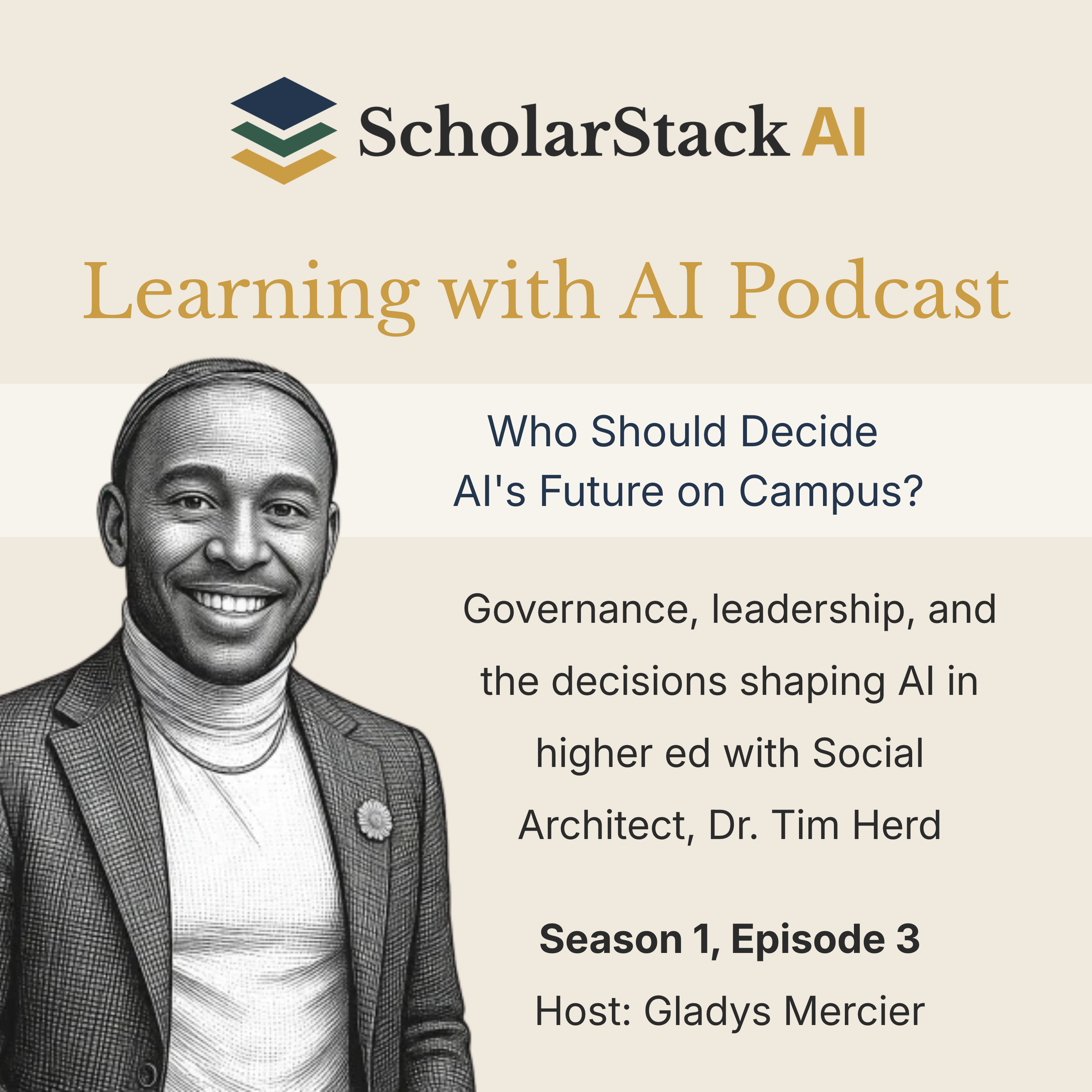
Who Should Decide AI's Future on Campus?
Universities across the world are making decisions that will shape how artificial intelligence becomes part of teaching and learning. The challenge extends beyond selecting new technology. It requires leadership, institutional alignment, faculty engagement, and clear governance. In this episode of Learning with AI, Gladys Mercier talks with Dr. Tim Herd, higher education researcher and governance expert, about how colleges and universities can develop thoughtful strategies for adoption while balancing innovation, trust, academic values, and institutional priorities. Together they discuss: • Why university governance plays a central role in AI adoption • How faculty, administrators, and governing boards contribute to institutional strategy • Lessons from current initiatives across higher education • Building trust between institutions and technology providers • Creating campus-wide support while respecting the unique needs of different disciplines • Preparing students for a future where AI is part of everyday work and learning Whether you're a faculty member, dean, provost, instructional designer, or higher education leader, this conversation offers practical perspectives for making informed decisions about AI across your institution. Episode Overview Artificial intelligence is rapidly becoming part of university life, but successful adoption depends on more than selecting new technologies. Institutions must make decisions about leadership, governance, trust, and how AI aligns with their educational mission. In this episode of Learning with AI, host Gladys Mercier sits down with Dr. Tim J. Herd, higher education researcher, governance scholar, and organizational strategist, to explore how colleges and universities can develop thoughtful approaches to AI implementation. Drawing from his research on university governing boards and his experience advising institutional leadership on scalable generative AI adoption, Dr. Herd discusses why AI should be viewed as an institutional strategy rather than simply a technology initiative. Together, they explore governance, shared decision-making, faculty engagement, and the structures universities need to support meaningful AI adoption.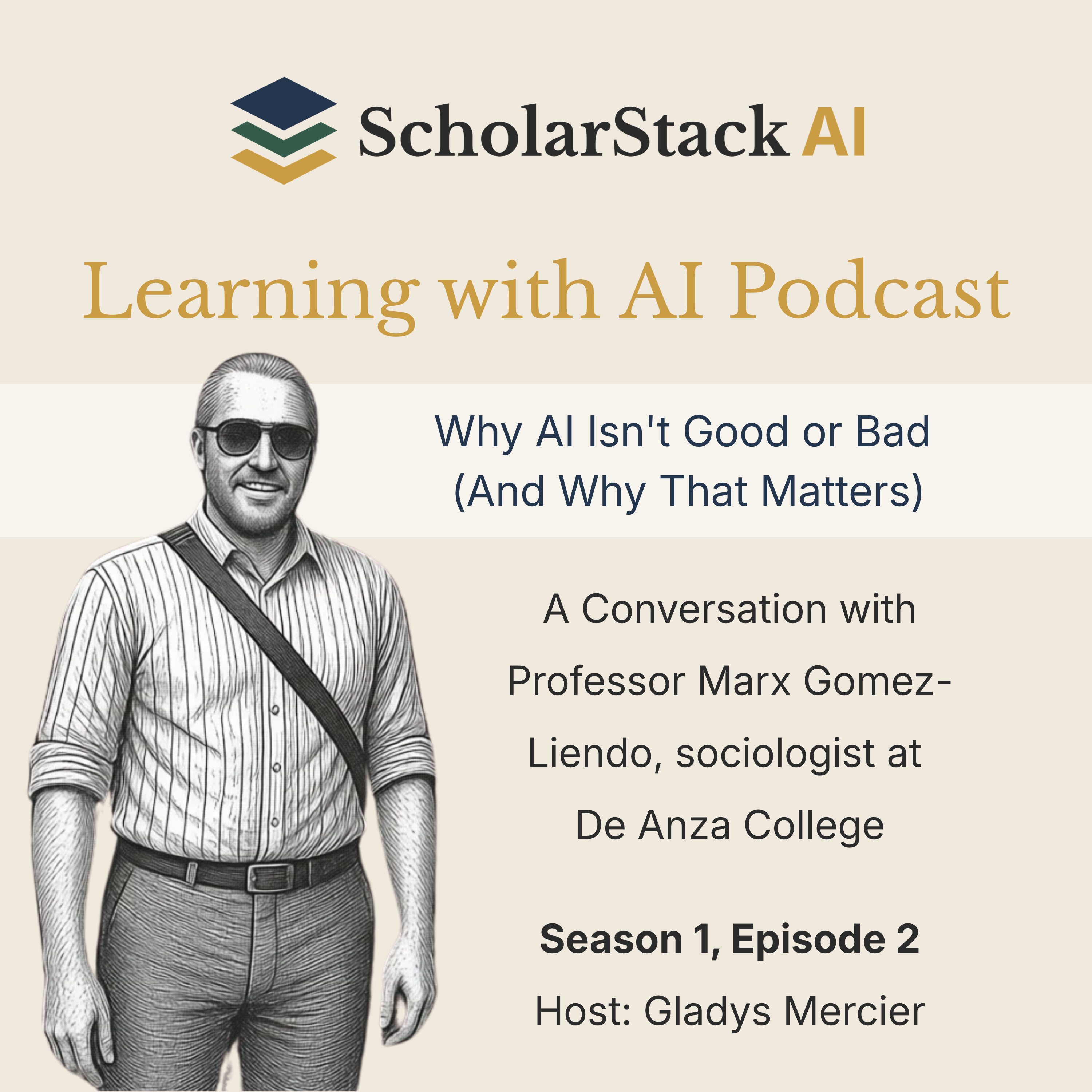
Why AI Isn't Good or Bad (And Why That Matters)
Intro: Welcome to Learning with AI, a ScholarStack podcast. In each episode we explore how artificial intelligence is changing the way we learn, teach and think. Through conversations with educators, researchers, students and academic leaders, we discuss the ideas and challenges shaping the future of learning. At ScholarStack we believe AI doesn't replace learning, it enhances it. AI isn't just changing education, it's changing society. Today professor Marx Gomez-Liendo shares why the most important questions about AI aren't just technological, but human. We hope you enjoy this conversation. Let's get started. Gladys Mercier: Welcome to Learning with AI, a podcast from ScholarStack. We bring together voices from across the academic world to explore how AI is changing the way we teach, learn, lead, and think. No hype, no easy answers—just honest conversations about a complicated moment. I'm your host, Gladys Mercier, and today I'm joined by Professor Marx Gomez-Liendo. Marx is a sociology professor at De Anza College. Welcome, Marx. To begin, it might be helpful for our audience if you could tell us: what does a sociological perspective bring to conversations like this? Marx Gomez-Liendo: Thank you, Gladys. I'm really excited to be part of this podcast. Simply put, sociology is the study of human interactions at different scales. We examine everything from small groups and communities to entire societies and global issues. We use different theoretical perspectives and research methods to better understand how people interact and how those interactions shape our world. One of sociology's strengths is connecting what often appears to be an individual problem to a much larger social context. For example, unemployment isn't only a personal issue—it is also connected to economic policies. Likewise, AI isn't just a technological innovation; it's connected to broader changes in education, government, and society. That's the perspective sociology brings to conversations like this. Gladys Mercier: Excellent. Thank you. What first sparked your interest in sociology, and what areas are you researching today? Marx Gomez-Liendo: It's actually a story that goes back to my childhood. My father studied political science, and my parents named me Marx after Karl Marx. When I was transitioning from high school to college, I became curious about my name and started reading Karl Marx's work. Through that process, I discovered sociology, and I immediately connected with it. I've always been someone who enjoys observing people and the world around me. Sociology requires curiosity, analytical thinking, and imagination to make connections between individual experiences and larger social structures. I often tell my students that I fell in love with sociology during my very first lecture. We were watching Modern Times by Charlie Chaplin, and something just clicked for me. As for my research, I've worked on a variety of topics over the years. As an undergraduate, I completed an honors thesis examining copyright and its impact on education and culture. Although I'm not a lawyer, I wanted to understand how copyright policies influence access to knowledge. That research introduced me to remarkable scholars and activists in my home country of Venezuela. Together, we even formed a small collective called Communalize Knowledge, which advocated for conversations around open education. Before moving to the United States, I also worked as a policy analyst and later became a research associate at a scientific institute in Venezuela, focusing on environmental sociology and political ecology. More recently, my work has explored open education and its relationship with decolonial theory. Alongside that, I continue researching topics such as energy transitions and mining conflicts in Latin America. Although those subjects may seem different, they're connected by one common goal: bringing multiple perspectives into complex conversations. I believe