


 Gladys Mercier
 Dr. Tim Herd
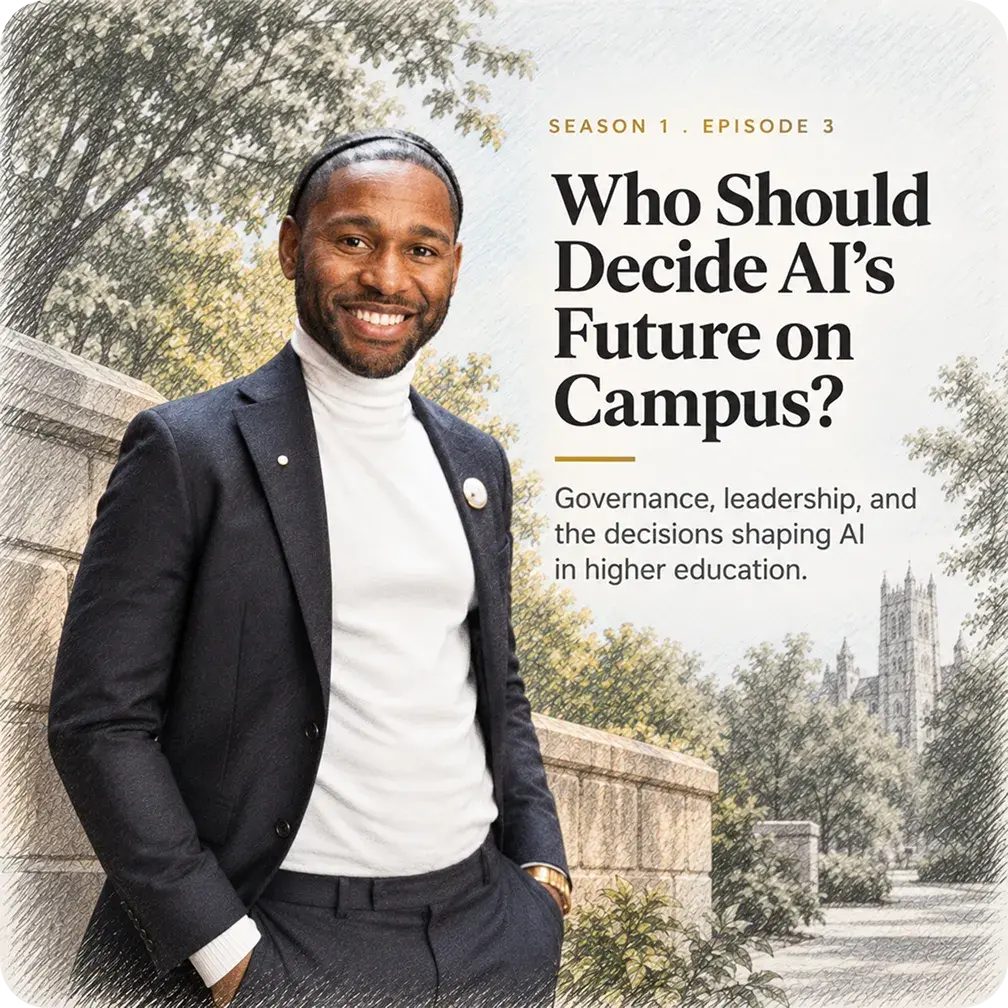
LEARNING WITH AI . SEASON 1 . EPISODE 3
Dr. Tim Herd - Social Architect • Hosted by Gladys Mercier • October 16, 2026
Episode Overview
Artificial intelligence is rapidly becoming part of university life, but successful adoption depends on more than selecting new technologies. Institutions must make decisions about leadership, governance, trust, and how AI aligns with their educational mission.
In this episode of Learning with AI, host Gladys Mercer sits down with Dr. Tim J. Herd, higher education researcher, governance scholar, and organizational strategist, to explore how colleges and universities can develop thoughtful approaches to AI implementation.
Drawing from his research on university governing boards and his experience advising institutional leadership on scalable generative AI adoption, Dr. Herd discusses why AI should be viewed as an institutional strategy rather than simply a technology initiative.
Together, they explore governance, shared decision-making, faculty engagement, and the structures universities need to support meaningful AI adoption.
Governance Shapes AI Adoption
Universities rarely make significant institutional changes through a single office or department. Instead, decisions emerge through relationships among governing boards, presidents, provosts, faculty, staff, and students.
Dr. Herd explains how these governance structures influence the way institutions approach AI, why implementation often varies across departments, and how shared governance can either accelerate or slow institutional change.
Rather than viewing AI as an isolated technology purchase, universities have an opportunity to integrate it into broader conversations about academic priorities, student success, and long-term institutional strategy.
“A lot of administrations were really seeing AI not as a governance and strategy issue, but more as a technical procurement issue.”
From Technology to Institutional Strategy
Many AI conversations begin with tools.
This conversation begins with institutional leadership.
Dr. Herd argues that adapting AI successfully requires alignment across multiple levels of the university—from governing boards and executive leadership to faculty and academic departments.
Instead of asking which platform to purchase first, institutions benefit from asking broader questions:
How does AI support the university’s mission?
How will faculty be supported?
How will success be evaluated?
Who should participate in these decisions?
Viewing AI through this institutional lens helps create more sustainable strategies that extend beyond individual technologies.
Faculty Need Support, Not Just Access
Throughout the conversation, Dr. Herd shares insights from his work as Practitioner in Residence at De Anza College, where he partnered with faculty and institutional leadership to better understand how instructors were approaching generative AI.
Rather than focusing solely on training faculty to use new tools, the initiative emphasized dialogue, resource sharing, and understanding where educators were in their own AI journey.
Some faculty were already experimenting confidently.
Others wanted practical guidance before bringing AI into their classrooms.
Supporting both groups required creating opportunities to learn together rather than expecting immediate adoption.
Building Trust Across Campus
Technology alone does not create institutional change.
People do.
One recurring theme throughout the episode is trust.
Faculty are more likely to embrace new initiatives when they feel included in the process and when institutional leaders create opportunities for collaboration rather than top-down implementation.
Dr. Herd suggests that successful AI adoption depends on partnerships between universities and external technology providers, while also empowering faculty champions and AI fellows within the institution to help bridge those conversations.
Building trust creates stronger implementation and encourages participation across campus.
Preparing Students for an AI-Enabled Future
As AI becomes part of everyday work, universities face an important responsibility: preparing students to use these technologies thoughtfully.
Dr. Herd discusses how institutions can help students develop practical AI skills while preserving critical thinking, academic integrity, and meaningful learning.
Rather than avoiding AI, higher education has an opportunity to teach students how to engage with it responsibly and intentionally.
The conversation also explores why AI literacy should become part of students’ broader professional preparation, regardless of discipline.

About Dr. Tim J. Herd
Dr. Tim J. Herd is a researcher, strategist, and self-described social architect whose work focuses on improving complex institutional systems.
He recently earned his Ph.D. in Higher Education & Organizational Change from UCLA, where his research examined university governing boards, power dynamics, and institutional decision-making.
As Practitioner in Residence in the Social Science & Humanities Division at De Anza College, he advised institutional leadership on scalable generative AI adoption.
Beyond his academic work, Dr. Herd serves as Director of Strategy & Culture for the Doctoral Student Writing Collective, supporting more than 700 historically underrepresented doctoral students through writing and professional development. He also serves as Chief Visionary Officer of Black Doctors Create, where he develops programs that foster professional growth and interdisciplinary collaboration for doctoral-level practitioners across the Los Angeles area.
Key Takeaways
- AI implementation is fundamentally an institutional leadership challenge.
- Shared governance plays a central role in how universities adopt emerging technologies.
- Faculty engagement and collaboration strengthen institutional AI strategies.
- Trust between leadership, faculty, and technology partners supports successful adoption.
- Resource hubs and faculty communities help scale AI adoption across disciplines.
- Universities have an opportunity to prepare students for a future where AI becomes part of everyday professional practice.
Episode Transcription
Intro: Welcome to Learning with AI, a ScholarStack podcast. In each episode we explore how artificial intelligence is changing the way we learn, teach, and think. Through conversations with educators, researchers, students, and academic leaders, we discuss the ideas and challenges shaping the future of learning.
At ScholarStack, we believe AI doesn’t replace learning—it enhances it.
We hope you enjoy this conversation. Let’s get started.
Gladys Mercer: Welcome to Learning with AI, a podcast from ScholarStack. We bring together voices from across higher education to explore how AI is changing the way we teach, learn, lead, and think. No hype, no easy answers—just honest conversations about an important moment in education.
I’m your host, Gladys Mercer, and today I’m joined by Dr. Tim Herd.
Tim is a higher education researcher, organizational strategist, and self-described social architect whose work focuses on improving complex institutional systems. His research examines university governance, leadership, and institutional decision-making, and he has advised colleges on scalable approaches to generative AI adoption.
Tim, welcome.
Dr. Tim Herd: Thank you so much for having me. I’m excited to be here and to talk about governance, higher education, and artificial intelligence.